

CEO of Power Inside Out | Commercial Strategy, Sales and Leadership
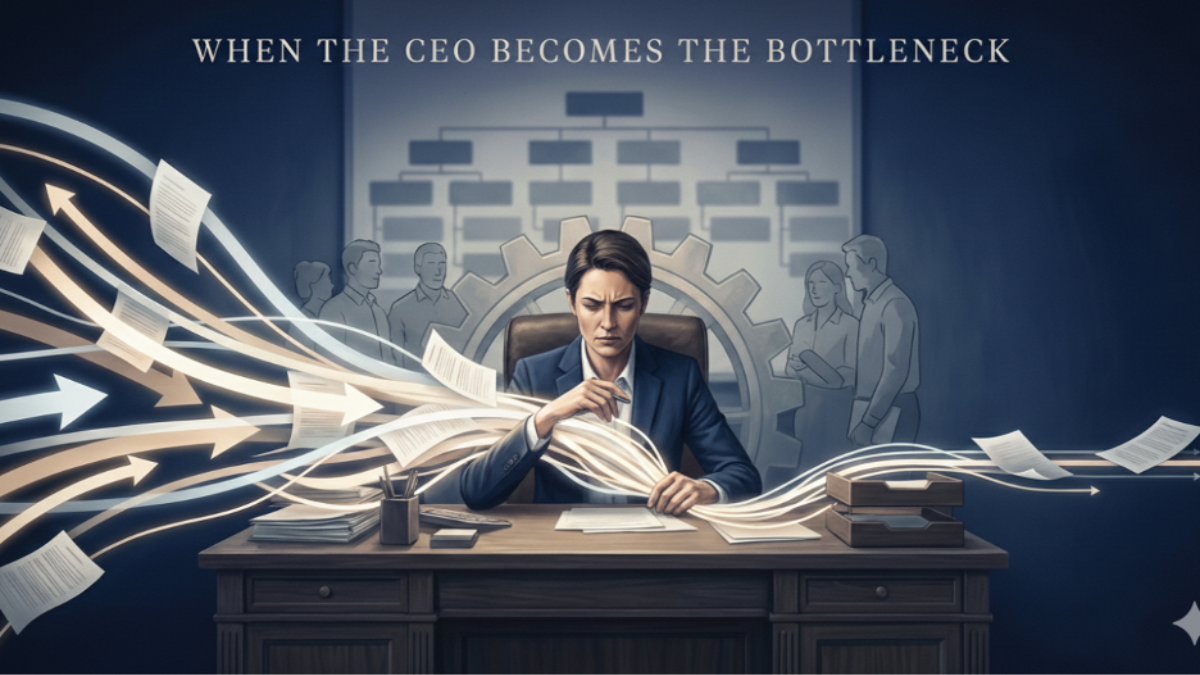
Becoming a bottleneck leader doesn't usually happen overnight. Often, it starts by being the person who best solves problems, makes decisions, and gets things moving forward.
A country manager once told me something I hear more often than many leaders imagine: “My organization isn’t moving at the speed I need it to. I’m fully committed. I work many hours. My schedule is full. I even meet with clients myself.”.
In addition, she was the best salesperson on the team. She opened up business, generated opportunities, and she passed them on to her team so that they could close them. On the surface, she seemed like a strong leader. In reality, she was a warning sign: the sign of a bottleneck leader.
I heard the same story from CEOs of growing companies and leaders within large organizations. When results stall, leaders step in. They intervene, compensate, and become the driving force again. More effort, more hours, and less speed.
An organization that works on people
The commitment and talent are there. What happens is that the organization works on people, without its own engine.
When the leader is also the best salesperson, the one who makes the key decisions and who gets everything done, the organization relies on a single finite resource: its time and energy. The same risk appears when the results depend on a few “heroic players” within the teams. Performance comes from individuals and not from the system, and that doesn’t scale.
After a certain size, often between 70 and 100 people, complexity grows faster than capacity. Adding people increases coordination, but not speed. Costs rise, margins shrink, and decisions become slower.
How to know if you are the bottleneck
If you want to know if your organization has this problem, look for some simple signs:
- The results improve only when senior leaders intervene.
- The key decisions await only one person.
- Leaders engage in business, problems, or approvals that should not require them.
- The supply grows faster than productivity.
- People are busy, but the results are not accelerating.
When these signs appear, the organization is not yet a motor.
How to stop being a bottleneck leader
The necessary change is uncomfortable, but essential: leaders have to move from making to designing. Designing also does not mean abandoning manual intervention. It means creating the conditions for the organization to function without constant manual intervention.
Some practical moves:
- Creating clarity through strategy. Everyone has to understand where the organization is going and why. The strategy serves as a shared filter for decision-making, allowing for action without waiting for approval, and that’s why it has to live beyond a presentation.
- Defining how decisions are made. Make it clear who decides what, at what level and with what information. If all decisions are escalated, speed disappears.
- Build simple and repeatable processes. Focus on the few critical processes that generate results. They must be reliable, measurable, and understood by everyone.
- Delegate decisions, in addition to tasks. Give your leaders real responsibility. Accept that some decisions will be different from the ones you would make. That is the cost of scaling up.
- Aligning what success means. Define what success means in the short and long term. Without a shared definition of success, effort becomes scattered and impact is not achieved.
From hero to engine builder
This challenge goes far beyond CEOs. Country managers, business unit leaders, and leaders at any level face the same risk. From the moment progress depends on you personally intervening, the engine is not yet built.
Leading on a scale means building the engine, rather than being the hero. If your organization works harder and advances more slowly, asking for more effort won’t solve the problem. It’s worth asking another question: am I dedicating my time to making, or designing the engine that should work without me?
This is the change we see time and again in our work at Power Inside Out: leaders who sustained growth through personal effort until scale required clarity, strategy, and systems. The leap rarely comes from working harder. It comes when an organization is built to move faster than any individual.
If this resonates with you, take a moment to pause: In what part of your organization are results still dependent on you intervening? That answer usually points to the next system you need to design.