
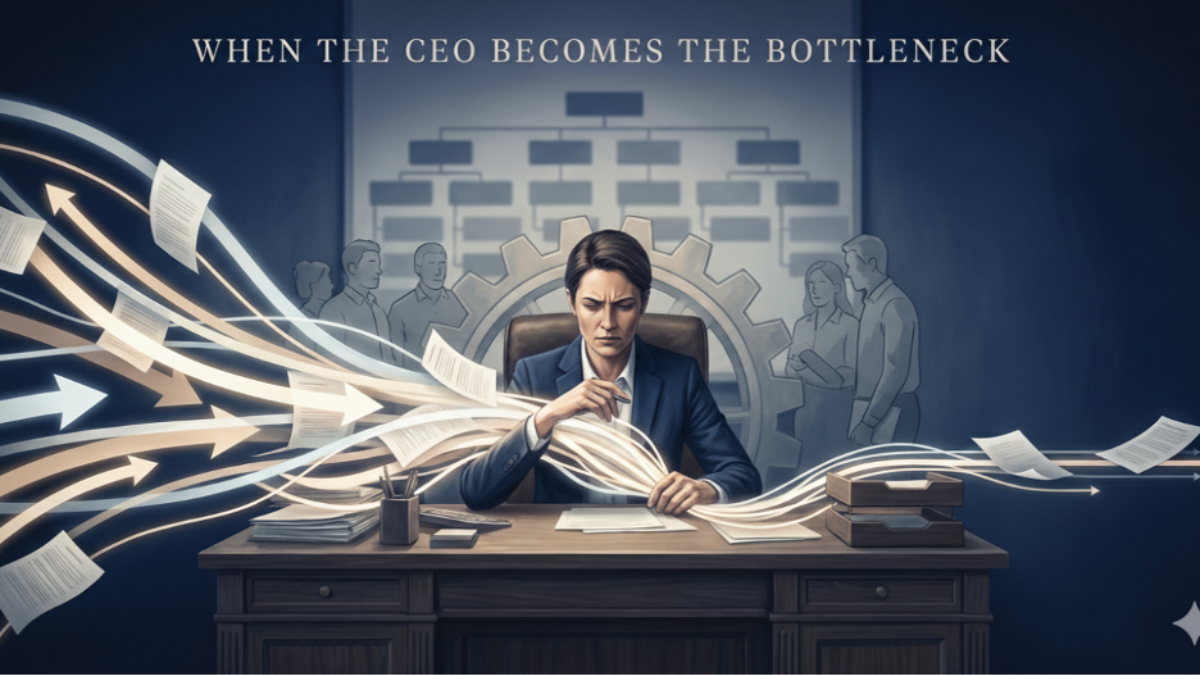
When Leaders Become the Bottleneck

When Leaders Become the Bottleneck

Driving Rapid Growth for Your Company with Fortune 500 Best Practices | Digital Transformation Leader | Leadership Development | Sales Director | Certified Organizational Coach |

January 21, 2026 A familiar story. A country manager once shared something I hear more often than many leaders expect: “My organization is not moving at the speed I need. I’m fully committed. I work long hours. My calendar is full. I even meet clients myself.” She was also the best seller on the team. She opened deals, created opportunities, and passed them to her team to close. On the surface, it looked like strong leadership. In reality, it was a warning sign. I’ve heard the same pattern from CEOs of growing companies and leaders inside larger organizations. When results slow down, leaders do more. They step in, compensate, and become the engine again.
  • More effort.
  • More hours.
  • Less speed.
The real problem The issue is not commitment or talent. | The issue is that the organization is running on people, not on an engine. When a leader is the top seller, the main decision-maker, and the person who unblocks everything, the organization depends on a single finite resource: that leader’s time and energy. The same risk appears when results depend on a few “hero players” inside teams — performance comes from individuals, not from the system. That does not scale. At a certain size — often between 70 and 100 people — complexity grows faster than capacity. Adding more people increases coordination, not speed. Costs go up. Margins tighten. Decisions slow down. If you want to see whether your organization has this problem, look at a few simple signals:
  • Results improve only when senior leaders step in
  • Key decisions wait for one person
  • Leaders are involved in deals, issues, or approvals that should not require them
  • Headcount grows faster than productivity
  • People are busy, but outcomes don’t accelerate
When these signals appear, the organization is not an engine yet. How to avoid the trap The shift required is uncomfortable — but necessary. | Leaders must move from doing to designing. Designing does not mean disengaging. It means building the conditions for the organization to run without constant manual input. A few practical moves:
  1. Create clarity through strategy Everyone must understand where the organization is going and why. Strategy is not a slide deck. It is a shared decision filter that helps people act without waiting for approval.
  2. Define how decisions are made Make explicit who decides what, at what level, and with what information. If every decision escalates, speed disappears.
  3. Build simple, repeatable processes Focus on the critical few processes that drive results. They should be reliable, measurable, and understood by everyone.
  4. Delegate decisions, not just tasks Give leaders real ownership. Accept that some decisions will be different from yours. That’s the cost of scale.
  5. Align on what success looks like Define what winning means — short and long term. Without a shared definition of success, effort spreads but impact doesn’t.
From hero to agent builder This challenge is not limited to CEOs. Country managers, business unit leaders, and organization leaders at any level face the same risk. The moment progress depends on you personally stepping in, the engine is not built yet. Leadership at scale is not about being the hero. It’s about building the engine. If your organization is working harder but moving slower, don’t ask for more effort. Ask a different question: Am I spending my time doing — or designing the engine that should run without me? This is the shift we see repeatedly in our work at Power Inside Out. Leaders who carried growth through personal effort — until scale required clarity, strategy, and systems. The breakthrough is rarely about working harder. It’s about building an organization that can run faster than any individual ever could. If this resonates, pause for a moment and reflect: Where in your organization are results still depending on you stepping in? That answer usually points to the next system that needs to be designed.